

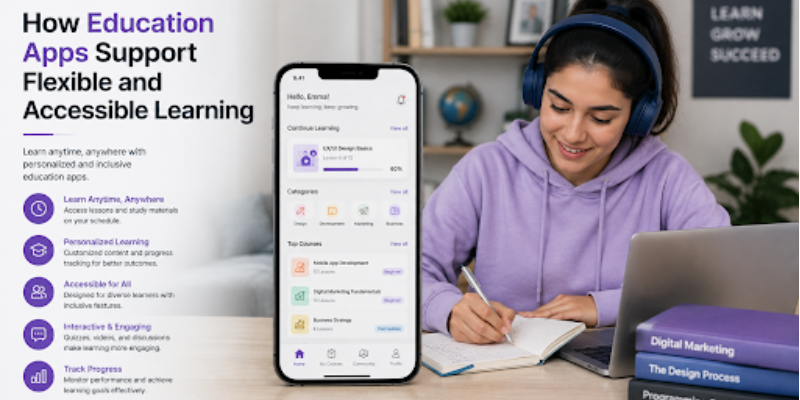
How Education Apps Support Flexible and Accessible Learning
A single mother I know completed her accounting certification while working full time and raising two kids under seven. She studied in fifteen-minute windows on the bus, during lunch, after bedtime when she had twenty minutes before exhaustion took over. She didn't have the option of sitting in a classroom three evenings a week. She needed learning that could happen in fragments, picked up and put down dozens of times across a week, that remembered where she'd left off and didn't require her to reconstruct context every time she reopened the app.
She passed her certification exam on the first attempt.
The institution that offered her certification didn't make that possible. The app that delivered the content did by being designed for exactly the kind of fragmented, high-stakes learning that her life required rather than for the idealized student with uninterrupted study blocks and a quiet desk. That design specificity is the difference between education technology that expands who can learn and technology that merely digitizes the same access barriers in a different format. A thoughtful Education App Development Service understands this distinction at a foundational level, because building for flexible and accessible learning requires different architectural and pedagogical decisions than building a content delivery platform that happens to run on a phone.
What Flexible Learning Actually Requires Technically
Flexibility in learning isn't just about mobile access. It's about continuity across fragmented sessions, and continuity requires specific technical decisions that content platforms often skip.
Progress synchronization that works correctly across devices picking up a lesson on a phone where a tablet session ended, having quiz scores and completion states accurate regardless of which device was used last sounds basic and requires deliberate engineering to do reliably when users switch between devices, lose connectivity mid-session, or close an app without explicitly saving. The learner who reopens an app and finds their progress has been lost or partially reset doesn't just lose time. They lose confidence in the platform, and lost confidence in learning technology is harder to recover from than lost progress in any other app category because it compounds with the vulnerability most adult learners already bring to educational contexts.
Offline functionality is critical for learning apps in ways it isn't for many other categories. Learning happens in contexts where connectivity is unreliable commutes through tunnels, rural areas, international travel where data costs are prohibitive. An app that requires constant connectivity excludes learners precisely in the moments when they're most likely to have free time transit, waiting rooms, anywhere that isn't their home or office. Lesson content downloaded for offline use, with progress synced when connectivity returns, serves the fragmented learner's actual life pattern rather than an idealized one.
Spaced repetition systems algorithms that schedule review of material at intervals calibrated to how close to forgetting the learner is require session-level data tracking that goes beyond simple completion states. The app needs to know not just that a user has seen a flashcard but when they saw it, whether they got it right, and how confident they indicated they were. This granular data, accumulated across many sessions and many content items, is what makes adaptive review schedules possible. Building the data model for it correctly from the start is significantly easier than retrofitting it.
Accessibility as a Design Requirement, Not a Feature
Education apps that genuinely serve diverse learners treat accessibility as a foundational design constraint rather than a compliance checkbox.
Screen reader compatibility matters in education apps more than in most consumer applications because cognitive and visual differences are common among adult learners returning to education after gaps, and because the educational content itself text, diagrams, mathematical notation is more varied and more structurally complex than the content most apps present. Mathematical notation accessible to a screen reader requires semantic markup that visual-only presentation doesn't. Diagrams that carry information need text descriptions that convey the same information, not generic alt-text that says "chart" without describing what the chart shows.
Caption quality for video content in education apps carries higher stakes than in entertainment contexts, because the content is trying to teach something rather than entertain. A caption that misses a technical term, mispunctuates a sentence in a way that changes its meaning, or drops a word from an explanation creates a learning gap rather than a viewing inconvenience. Building video content pipelines with caption review as a required step rather than an automated afterthought serves learners who depend on captions and the number who depend on them is consistently larger than app teams expect, including users in noisy environments, users in quiet environments where audio isn't practical, and users processing content in a second language.
Adjustable content presentation font size, line spacing, background contrast, dyslexia-friendly font options affects a larger share of learners than these options appear to target. Many adult learners have never been formally identified as having reading difficulties but navigate text more effectively with presentation adjustments that standard interfaces don't provide. Offering these options and making them easy to find and change reduces the cognitive load of engaging with content for learners who need them and costs nothing for learners who don't.
Adaptive Learning That Actually Adapts
"Adaptive learning" appears in the marketing of many education apps and describes genuinely different things depending on what the adaptation actually does.
At the shallow end, adaptive means content branches based on quiz scores users who score above a threshold skip material, users below repeat it. This is better than purely linear content but doesn't address the variation in how different learners best acquire and retain different types of information.
At the deeper end, genuinely adaptive systems track performance across multiple dimensions accuracy, response time, error pattern analysis, engagement duration, session frequency and use that multidimensional signal to sequence content in ways that serve how a specific learner is actually progressing rather than how an average learner progresses. A learner who consistently struggles with a specific concept type might be served by a different explanation approach, a more concrete example, or more frequent low-stakes practice rather than simply being shown the same explanation again.
Building this kind of adaptation requires both a data model rich enough to capture the relevant dimensions and a content architecture flexible enough to serve the same learning objective through multiple approaches. Neither is simple to build, and both require educational design expertise alongside engineering expertise the content decisions and the technical decisions have to be made together.
Community and Accountability Features That Aren't Gimmicks
Learning in isolation has higher drop-off rates than learning with some form of social accountability, and education apps have attempted to address this with features ranging from genuine to gimmicky.
Study groups that allow learners working through the same content to communicate and support each other require moderation infrastructure and community design that's harder than it looks. An unmoderated learner forum degrades quickly into a mix of off-topic discussion, incorrect information presented confidently, and discouraging content that reduces rather than increases motivation. Building community features that reliably improve learning outcomes requires both technical infrastructure and active management that ongoing operational cost needs to account for.
Cohort-based progress showing learners how they're progressing relative to others who started at the same time works as a motivation mechanism for some learners and backfires for others. Learners who are progressing faster than peers find it validating. Learners who are progressing slower find it discouraging in ways that accelerate drop-off. Designing accountability features that serve motivation without punishing the learners most at risk of dropping out requires more nuance than leaderboards provide.
Commitment devices features that create accountability to external commitments a learner has set for themselves tend to work better than social comparison features across diverse learner populations. A learner who has committed to thirty minutes of study five days a week and receives a gentle check-in when they've been absent for two days is engaging with their own stated intention. The same learner seeing they're in the bottom quartile of cohort progress is engaging with a comparison they didn't ask for.
Where the Genuinely Good Ideas in EdTech Are Right Now
Among the top mobile app ideas in education gaining real traction, a few directions stand out for how specifically they address learning access problems that haven't been solved by general-purpose platforms.
Microlearning platforms built for professional skill development structured specifically for the five-to-fifteen-minute session windows that working adults actually have have found audiences that traditional online courses never reached because the course format itself was incompatible with those learners' lives. The accounting certification student's experience isn't unusual. It's the norm for a significant share of the adult learning market.
Language learning apps that use AI conversation partners to simulate speaking practice have addressed the most difficult access problem in language acquisition: the shortage of qualified conversation partners willing to spend time with beginners. Speaking practice that was previously only available through expensive tutors or immersion environments is becoming accessible through apps that provide a patient, available, non-judgmental practice partner at any hour.
Skills verification platforms that pair learning content with assessments trusted by employers creating a direct path from learning to recognized credential address the value realization problem that general learning platforms have struggled with. Learners are motivated by outcomes. Platforms that can point to a clear outcome a credential that influences hiring decisions retain learners better than platforms whose primary value is the intrinsic satisfaction of learning.
The Design Principle That Holds Across All of It
The accounting certification student didn't need a better classroom. She needed something that was architecturally incompatible with a classroom designed from the beginning for fragmented sessions, offline access, and progress that persisted across every opening and closing of the app across weeks of study.
Every genuinely useful education app starts from the learner's actual life rather than from an idealized version of it. What time does this person have, in what contexts, with what interruptions, and with what competing demands on their attention and energy? Building for that reality, rather than for an imaginary learner with uninterrupted blocks of study time, is what produces apps that expand access rather than apps that digitize the same access barriers that classrooms already have.
The accounting student passed on the first attempt. That outcome started with a design decision someone made about how the app would handle a session that ended mid-lesson on a bus.